The deep sky changes with the seasons as Earth moves around the Sun and the night side faces different directions into the galaxy. From Canadian latitudes — roughly 43°N in southern Ontario and British Columbia to 51°N in central Alberta and Saskatchewan — the accessible sky covers essentially the full sky from south of declination -35° to the north celestial pole. This means most of the northern hemisphere's classic deep-sky targets are at least partially accessible, though objects that never rise far above the southern horizon are disadvantaged compared to what observers at 35°N can see.
The seasonal categories below refer to evening sky targets — objects well-placed in the evening hours during those months. Each object can technically be observed outside its "season" by waiting until after midnight, but the evening window is when most casual observing happens.
Latitude Notes
- Southern Ontario / Vancouver Island (~43–49°N): Best access to southern objects like Scorpius and Sagittarius.
- Prairie provinces (~50–52°N): Good compromise between dark skies and southern horizon.
- Northern BC / Alberta above 55°N: Extended summer twilight reduces usable dark time; compensated by very dark skies.
Winter (December – February)
Winter evenings point toward the Orion-Taurus star formation regions and the rich open clusters of the Milky Way running through Auriga and Gemini. The winter sky is arguably the most dramatic of any season at Canadian latitudes: Orion, Taurus, Gemini, Auriga, and Canis Major are all visible simultaneously.
Orion Nebula (M42)
The Orion Nebula is the brightest and most detailed nebula in the northern sky, visible to the naked eye as the middle "star" in Orion's sword. In any telescope, it shows a complex structure of glowing gas organized around the Trapezium — a multiple star system of four hot O-type stars whose ultraviolet radiation ionizes the surrounding material. At 150–200mm aperture with medium power (60–100×), four Trapezium stars are easily resolved, and the surrounding nebulosity extends well beyond the field of view at low magnification.
In Canadian winters, M42 transits the meridian at a useful height (about 35–45° altitude from southern Canadian sites) in mid-evening from December through February. The cold, dry air of a Canadian winter often provides excellent transparency, making faint nebular extensions visible that would be lost in humid summer air.

The Orion Nebula (M42) — Hubble Space Telescope mosaic. Image: NASA / ESA / Wikimedia Commons (public domain)
Pleiades (M45)
The Pleiades open cluster in Taurus is visible to the naked eye as a compact group and has been recognized in the mythologies of cultures on every inhabited continent. Through binoculars or a rich-field telescope at low power (20–30×), it is one of the finest objects in the sky. At very dark sites (Bortle 2–3), faint reflection nebulosity wrapping several of the brighter stars becomes visible with averted vision in larger apertures.
Beehive Cluster (M44)
M44 in Cancer is a large, loose open cluster that fills about 1.5° of sky — three times the apparent diameter of the full Moon. It is a naked-eye object under dark skies (it was used by ancient observers to predict weather), and at low magnification through binoculars or a rich-field telescope it resolves into dozens of individual stars. At Canadian latitudes it reaches useful heights in evening from about January through April.
Winter Other Highlights
- M1 (Crab Nebula) in Taurus — supernova remnant; small and oval at moderate magnification; requires dark skies to see structure.
- M35 in Gemini — rich open cluster; background cluster NGC 2158 visible in larger apertures as a faint haze behind the main group.
- NGC 1502 and Kemble's Cascade — a striking chain of stars in Camelopardalis, visible best as a low-power binocular sweep.
Spring (March – May)
The spring sky's defining feature is the Virgo Supercluster — the vast concentration of galaxies filling the Virgo-Coma Berenices region. Spring evenings also provide access to galaxies in Leo, Ursa Major, and Canes Venatici. For observers north of about 50°N, some of the lower-declination Virgo galaxies are disadvantaged by their low altitude.
Virgo Galaxy Cluster
Centered on the giant elliptical galaxy M87 and extending through much of Virgo into Coma Berenices, the Virgo Cluster contains several thousand galaxies, of which dozens are within reach of a 150–200mm telescope. The brightest members — M84, M86, M49, M58, M60, M87 — appear as fuzzy elliptical smudges at moderate magnification. The challenge is navigation: the region is so dense with galaxies that a detailed finder chart is necessary.
Leo Triplet (M65, M66, NGC 3628)
Three galaxies in Leo fit within the same low-power field of view. M65 and M66 are edge-on inclined spirals with visible elongation; NGC 3628 is a thin edge-on galaxy with a faint dust lane visible in apertures above 200mm at good sites. At 150mm and a Bortle 3 site, all three are visible in the same low-power field.
M81 and M82
The Bode's Galaxy (M81) and Cigar Galaxy (M82) in Ursa Major are circumpolar from most Canadian sites — never setting below the horizon at latitudes above 45°N. This means they can be observed year-round, but their highest altitude occurs in late spring. M81 is a face-on spiral; M82 shows a visually distinct irregular structure with a bright core and irregular outer regions.
Summer (June – August)
Summer offers the Milky Way at its most impressive from Canadian latitudes: the galactic core and Sagittarius region rise to their maximum altitude of the year, though from latitudes above 50°N this remains relatively low in the southern sky. The compensation is the richness of northern Milky Way fields in Cygnus and Lyra, which are almost overhead.

The Pleiades (M45) in Taurus. Image: NASA / ESA / AURA / Caltech / Wikimedia Commons (public domain)
Ring Nebula (M57)
M57 in Lyra is the most observed planetary nebula in the sky — a shell of ionized gas ejected by a dying star. At 100× or more it appears as a distinct smoke ring with a slightly darker interior. The central white dwarf is present but requires apertures of 250mm+ and dark skies to see visually. From Canadian latitudes, Lyra passes nearly overhead in summer, giving excellent viewing conditions.
Dumbbell Nebula (M27)
At apparent size of about 8' × 5.7', M27 in Vulpecula is the largest planetary nebula in apparent angular size and is bright enough to show its double-lobed structure at moderate magnification (50–100×). Unlike M57, it is large enough that many observers initially overlook it at higher magnifications — low power shows it best.
Hercules Cluster (M13)
M13 is the showpiece globular cluster of the northern sky. At 150mm, it resolves partially into individual stars at the edges; at 200mm with good seeing, the inner regions begin to break up. It passes almost directly overhead from latitudes around 42–45°N in summer evenings, providing the best possible viewing angle. A second globular, M92, is only about 10° away and often overlooked — it is nearly as impressive.
Sagittarius Star Fields
From southern Canadian sites (latitudes below about 50°N), the Sagittarius region rises above the southern horizon in July and August evenings. The Lagoon Nebula (M8) and Trifid Nebula (M20) are visible to the naked eye as a hazy patch under good conditions; through a telescope at low power they show complex nebulosity. The richest Milky Way star fields visible from Earth are in Sagittarius and Scorpius, but from latitudes above 50°N these never rise more than 15–20° above the horizon, limiting their accessibility.
Autumn (September – November)
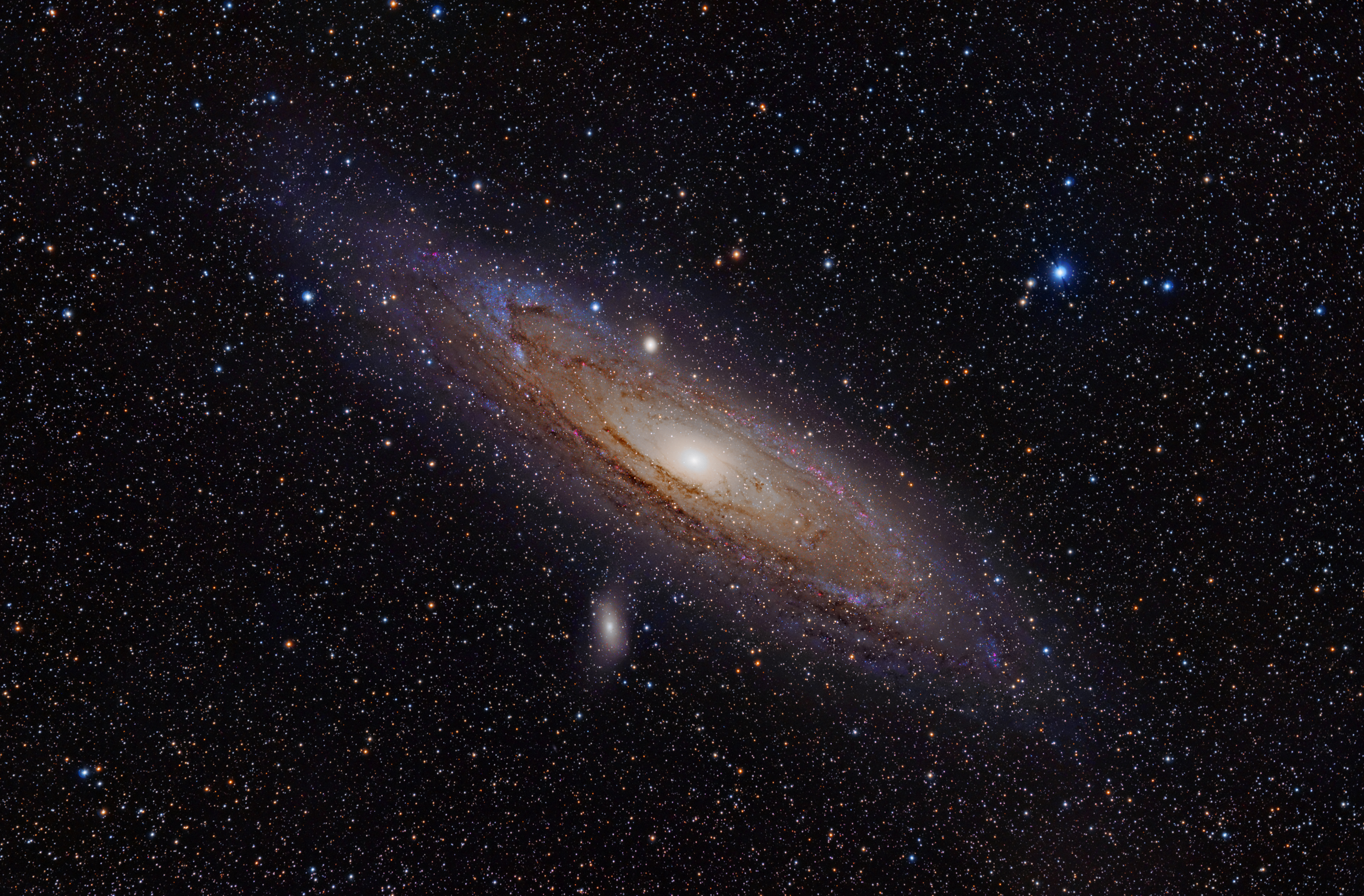
Autumn brings a shift away from the Milky Way core (now setting in the southwest) toward the galaxies of the Local Group and the rich double cluster in Perseus. The Andromeda Galaxy reaches its highest evening altitude in autumn and is the premier deep-sky target of the season.

Saturn photographed by the Cassini orbiter. Image: NASA / JPL / SSI / Wikimedia Commons (public domain)
Andromeda Galaxy (M31)
At 2.5 million light-years, M31 is the most distant object visible to the naked eye. It is also the largest deep-sky object in apparent angular size — its full extent, photographically, spans about 3° (six full Moon diameters). Under truly dark skies the naked-eye view shows an obvious glow; binoculars reveal an elongated smear. In a telescope at low power, the bright core and inner disk are easy, but the full angular extent is best appreciated at very low magnification or in binoculars.
M31's satellite galaxies M32 (a compact elliptical) and M110 (a diffuse spheroidal) are both visible in the same low-power field. M32 is point-like and easy; M110 requires averted vision under suburban skies but is straightforward from dark sites.
Double Cluster in Perseus (NGC 869 / NGC 884)
Two open clusters separated by about half a degree, both naked-eye objects from dark sites. At low power through any telescope they form a spectacular pair filling the field with stars of similar brightness. The two clusters have slightly different color distributions — several orange giant stars are prominent in NGC 884 compared to NGC 869. The Double Cluster is one of the most uniformly praised objects in the sky for visual observers at any experience level.
Triangulum Galaxy (M33)
M33 is the third-largest galaxy in the Local Group (after M31 and the Milky Way) and is positioned near Andromeda in the autumn sky. Despite its proximity in the cosmic sense, it is a difficult visual target because its large angular size distributes its light over a wide area, reducing the surface brightness. Under Bortle 3 conditions with dark adaptation, it is visible to the naked eye as a faint smudge. Through a telescope at low power it appears as a large, faint oval glow; the spiral arms require apertures above 250mm and very dark skies to discern visually.
Circumpolar Objects (Year-Round)
From latitudes above about 43°N, a band of sky around the north celestial pole never sets. This circumpolar region contains several worthwhile targets accessible year-round.
- M81 / M82 (Ursa Major) — brightest at southern culmination in late spring, but visible year-round from most Canadian sites.
- M97 (Owl Nebula) in Ursa Major — faint planetary nebula with two dark patches suggesting owl "eyes" in larger apertures.
- NGC 2403 in Camelopardalis — bright face-on spiral galaxy, often overlooked because it is not in the Messier catalog.
- Polaris — the North Star is a double star, with a faint companion visible at low magnification. Its position less than 1° from the celestial pole makes it useful for polar alignment.
Practical Notes on Seasonal Observing from Canada
Summer darkness in Canada is short. At latitude 50°N, astronomical twilight ends after 11 PM in mid-June; winter provides up to 11 hours of darkness. This makes autumn (September–October) and winter (January–February) the most productive seasons for extended dark-sky sessions.
The summer Milky Way is best seen from southern Canadian sites. Observers at 55°N or above rarely see the galactic core above 10° elevation; from 43–48°N the core reaches 15–20°, which while not impressive compared to tropical sites is sufficient to show the star clouds and major emission nebulae in Sagittarius.
For planning observing sessions, the RASC Observer's Handbook (published annually) contains monthly all-sky maps calibrated to 45°N and 52°N latitudes, lunar phases, planet positions, and deep-sky highlights for each month. It is available from the RASC website and from most Canadian astronomy retailers.